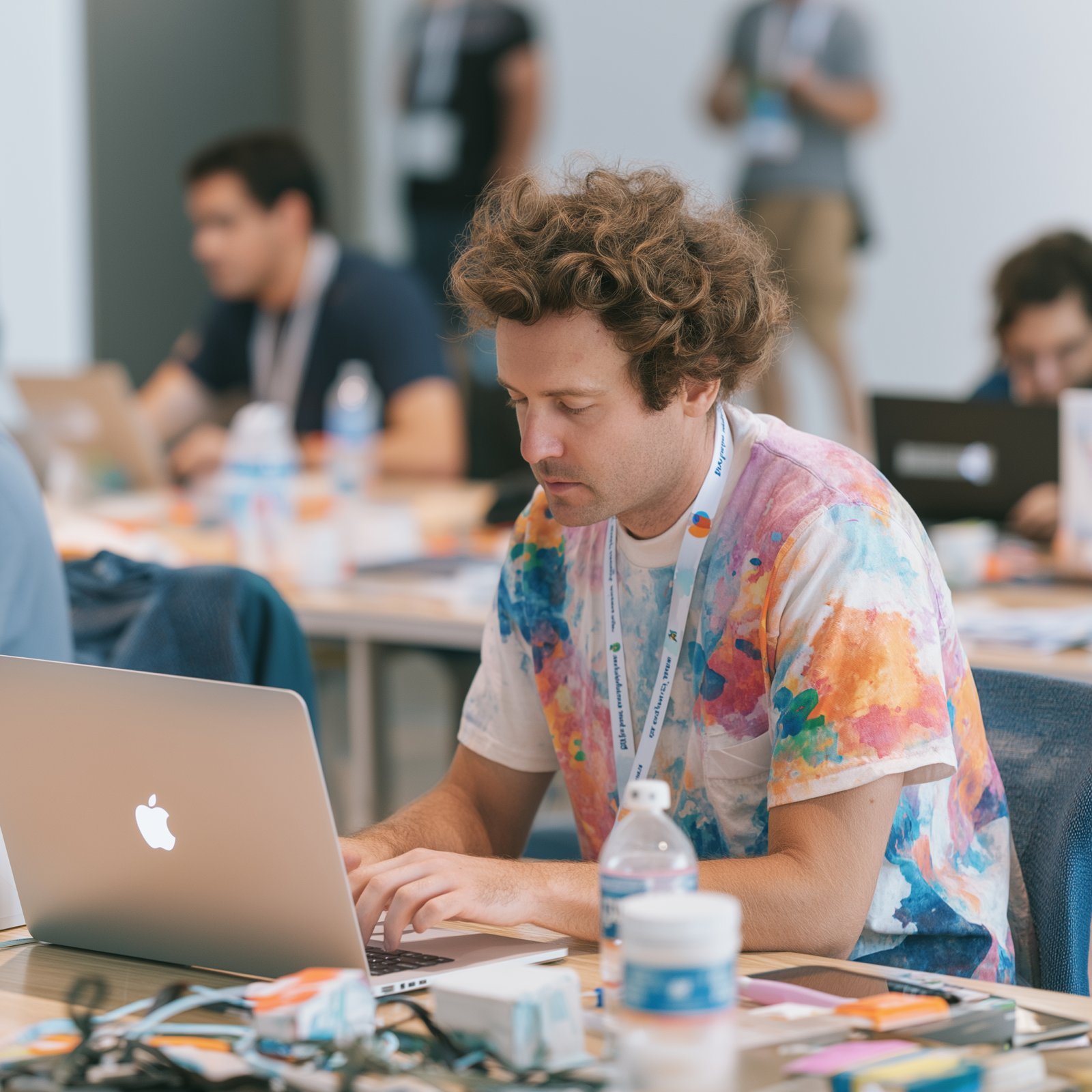
It's easy to build software that impresses engineers. It's harder to build software that helps the person who needs it most — the refugee who can't read the language on the form, the grandmother who just wired money to a scammer, the journalist trying to document atrocities before evidence disappears. sudo make world 2026 asked twenty-six teams to try.
The Problem With "Social Good" Hackathons
Most social good hackathons produce polished demos that solve problems nobody actually has. Teams build educational platforms for students who already have internet, healthcare tools that require smartphones the target population can't afford, civic platforms that assume users trust technology in the first place. The gap between "this would help people" and "this actually works for the people it claims to serve" is where most well-intentioned software quietly dies.
sudo make world ran February 27 through March 2, 2026, with a deliberately heavy weighting toward impact. Impact & Vision carried 35% of the scoring weight — more than Technical Execution (25%), Innovation (20%), Usability (15%), or Presentation (5%). The message was clear: we care about who this helps more than how clever the code is.
Six tracks offered different entry points — Education, Climate, Health, Civic, Tools, and Wildcard — but the strongest submissions ignored track boundaries entirely. The winning projects didn't fit neatly into categories because the problems they addressed don't fit neatly into categories either.
Twenty-six teams shipped. Two were disqualified during fair play review. Thirty-eight engineers evaluated the rest across three batches, producing detailed written feedback for every submission.
What Actually Worked
Witness: When Code Becomes Evidence
Team Witness won first place at 4.612/5.00 and swept all five category awards — a clean sweep that's rare in any competition. The platform transforms raw field testimony into ICC-standard evidentiary memos, maintaining a chain-of-custody protocol through every stage of processing. In human rights documentation, data integrity isn't a nice-to-have — it's the difference between testimony that holds up in international court and testimony that gets thrown out.
The technical pipeline is production-grade: Whisper large-v3 for timestamped transcription, Mistral Large for legal annotation, cross-referencing against ICC, UN, ACLED, Amnesty International, and Human Rights Watch databases. Test coverage spans rate limiter behavior, exponential backoff retry logic, cross-reference matching, and Zod schema validation on all API inputs.
"The standout submission of this hackathon, and one of the most purposeful civic tech projects we've seen at this level," wrote Irina Titova. "Bridging the gap between raw field testimony and ICC-standard evidentiary memos is a real, underserved problem that directly affects international justice outcomes."
Venkata Revunuru called it "a remarkably mature and well-executed project" but flagged a critical bug: the Whisper voice recording feature threw "unsupported format" errors on several audio types. "For a tool that relies on user-generated media in the field, robust media format handling is non-negotiable." The feedback is instructive — even the best project in the competition had a gap that would matter most in the exact scenario it was designed for.
Scam_BaitAI: Fighting Fraud With Fraud
NinjaCodes took second place at 4.587 with the competition's highest Impact & Vision score at 4.75. Instead of blocking scammers, Scam_BaitAI engages them — deploying AI-powered personas that waste scammers' time, extract intelligence, and protect real victims by keeping fraudsters occupied.
The stack is ambitious for 72 hours: LangGraph for agent orchestration, hybrid ML detection (TF-IDF + SVM), AsyncIO with session-based locking for 30+ concurrent conversations, a full voice pipeline through Twilio, Deepgram, and ElevenLabs, and anti-hallucination filtering on persona responses.
"Every minute the bot holds a scammer's attention is a minute they're not targeting a real victim like Mrs. Sharma," Titova noted. The framing matters — this isn't an abstract security tool, it's software that protects specific people from specific harm.
The team reported 87% intelligence extraction success, 12-minute average scammer engagement, and 4.2 data points per conversation — metrics that suggest real-world testing, not just demo performance.
NextPlate: Connecting Surplus to Need
Team BetterWorld earned third place at 4.462 with a food waste reduction platform connecting restaurants with surplus food, NGOs coordinating distribution, and customers seeking affordable meals. The project's strength wasn't the concept — food rescue platforms exist — but the domain depth. Ghost Meals (anonymous donations), Recipe Alchemist (surplus ingredient suggestions), and WRAP-based carbon tracking all demonstrated that the team studied the food waste ecosystem, not just the technology.
Revunuru praised "the multi-key Gemini pool with exponential backoff and strict adherence to WRAP methodology for carbon tracking" as evidence of "professional-grade approach to a complex logistics problem."
The Ones That Almost Won
Four projects scored between 4.125 and 4.375, and any of them would have been strong winners in a less competitive field.
Foresight by Decision Dynamo (4.375) built a structured decision-making tool that transforms abstract choices into comparable matrices with color-coded timelines, irreversibility flags, and scenario projections. Titova called the UI "genuinely impressive" but noted that the AI-generated scenarios tended toward generic outputs — the Berlin-specific context a user might enter didn't visibly shape the analysis.
LifeVault by DINooo (4.288) created a secure personal document vault for displaced populations. The offline-first, local-only approach is exactly the kind of design constraint that makes civic tech feel real rather than theoretical — emergencies don't wait for Wi-Fi, and refugees can't always trust cloud storage. Prakash Kodali was blunt: "This is solving a life-and-death problem. The offline-first approach is a smart and practical design decision."
AfterWord by Hanuman Force (4.125) tackled digital estate management after bereavement — helping families discover and close the accounts of deceased loved ones. The guardian verification system and AI-powered account discovery address a problem that millions of families face but rarely prepare for.
Offline-Learn by lossy bird (3.987) built an education platform designed to function without internet connectivity, targeting the 2.6 billion people worldwide without reliable access.
What the Judges Found
The evaluation panel included Arun Kumar Elengovan, Director of Security Engineering at Okta, whose identity infrastructure protects platforms serving 19,000 organizations. Nishant Motwani from Google and Sergii Demianchuk, Software Engineering Technical Leader at Cisco, brought perspectives from platforms operating at global scale. Sofia Kalinina provided detailed security and architecture assessments, consistently flagging exposed API keys, missing authentication, and absent input validation across submissions — the kinds of gaps that would undermine a social good tool's credibility with the vulnerable populations it aims to serve. Rajesh Kesavalalji contributed engineering leadership perspective across the evaluation.
These five senior evaluators worked alongside thirty-three additional judges including Irina Titova, Venkata Revunuru, Suprakash Dutta (AWS), Cihan Nam, Harun Sokullu, Abhinav Kasliwal, Oleksandr Pliekhov, Roman Seleznev, and others — producing detailed written feedback for every project.
Three patterns emerged from the evaluations:
The demo gap kills good ideas. Multiple strong concepts — ReliefNet-AI, RescueAI, DriveWise — lost significant ground because their demos were broken, their video links were dead, or their deployed versions returned blank pages. Harun Sokullu captured the dynamic precisely in one review: "Ship working project first, present it second." In a competition where judges can't verify your claims, the burden of proof is on you.
Mock features erode trust completely. Several teams described AI-powered features in their READMEs that turned out to be setTimeout calls followed by hardcoded responses. Sokullu, reviewing one such project, delivered the harshest feedback in the competition: "When a judge opens your code and finds that the 'video analysis' is a 5-second timer displaying fixed numbers, it damages trust in everything else you've built." Calling a prototype a prototype is fine. Calling a prototype AI-powered is not.
Domain expertise separates tools from toys. Witness understood ICC evidentiary standards. NextPlate integrated WRAP carbon tracking methodology. Scam_BaitAI studied scammer behavioral patterns well enough to build convincing counter-personas. The projects that scored highest were built by teams who spent time understanding the problem, not just the technology stack.
What Stays With You
Twenty-six teams shipped open-source tools for social good in 72 hours. Some built things that could genuinely help people. Others built impressive demos of things that don't exist yet. The gap between those two outcomes is not technical — it's attentional. The teams that scored highest paid attention to the person at the other end of the software: the journalist in a conflict zone who needs evidence that holds up in court, the elderly victim who needs a scammer kept on the line, the refugee who needs documents accessible offline.
The best code is code that helps someone. sudo make world 2026 proved that some teams already know that — and showed the rest what it looks like when you build with that conviction.
sudo make world 2026 was organized by Hackathon Raptors, a Community Interest Company (CIC #15557917) supporting innovation in software development. The event featured 26 teams competing across 72 hours, building open-source tools for social good across six tracks. Thirty-eight judges evaluated submissions across five weighted criteria: Impact & Vision (35%), Technical Execution (25%), Innovation (20%), Usability (15%), and Presentation (5%). Total prize pool: $2,500.
.jpg)