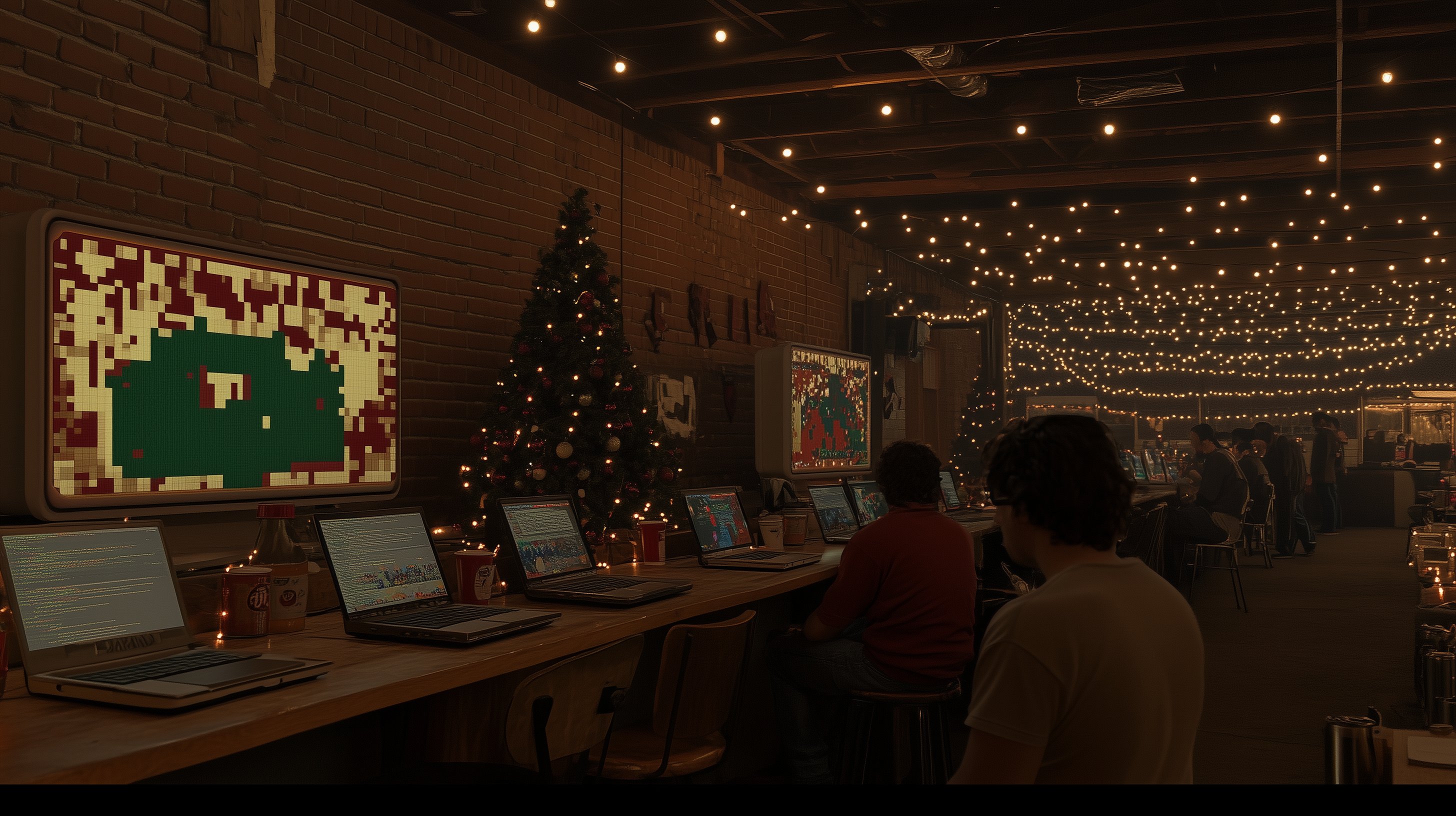
What happens when you combine 90s arcade nostalgia with Christmas chaos and a 72-hour deadline? You get Neuro Nostalgia 2026—a retro game jam where 25 teams shipped playable browser games in Rust, ranging from polished platformers to experimental horror hide-and-seek.
The Challenge: Christmas Arcade in 72 Hours
Neuro Nostalgia 2026 asked participants to build Christmas-themed 2D arcade games using Turbo, a Rust-based game engine that compiles to WebAssembly for in-browser play. Every submission had to be playable directly in the browser—no downloads, no installers. The competition ran December 19–22, with a preparatory workshop on December 13 covering Turbo's API and toolchain.
Turbo's core development team—Josiah Savary, Alex Feigenbaum, and LaTanya Donaldson—provided round-the-clock support on Discord throughout the event and later served as judges with doubled scoring weight, given their deep understanding of the engine's capabilities and limitations.
Five weighted criteria shaped evaluation: Gameplay & Fun Factor (30%), Arcade Authenticity (25%), Technical Execution (25%), Christmas Theme Integration (10%), and Innovation & Creativity (10%). The weighting reflected the event's priorities—games had to be fun first, authentically arcade second, and technically sound throughout.
What Participants Built
Santario: The Complete Arcade Package
Gifthunters built what judges recognized as the competition's most complete arcade experience. Santario is a 10-level Christmas platformer with a level-select UI featuring performance ranks, varied enemy types across stages, and a final boss fight against Krampus. The game earned the highest Christmas Theme Integration score in the competition at 4.82—judges described it as "seamlessly integrated throughout the experience."
What distinguished Santario was its end-to-end polish. Judges noted intuitive controls, clear progression, and satisfying audio cues—the end-of-level "hohoho" became a recurring highlight in feedback. The codebase reflected that ambition with broad Turbo usage across integrated systems for levels, enemies, boss mechanics, and settings. One evaluator identified a specific edge case where collecting the final gift triggered celebration audio, but dying immediately after returned the player to level select without unlocking the next stage—the kind of granular feedback that only comes from genuine engagement with a well-built game.
Santa Stealth: Turbo as the Engine
Batman's Santa Stealth earned the competition's highest Technical Execution score at 4.29 across 14 judges—the most heavily reviewed project in the competition. The top-down stealth game features vision-based enemy detection with 60-degree cones and a 160-pixel detection radius, alert propagation between nearby guards, a dual weapon system offering tactical choices between snowballs and guns, and a boss fight with an enrage phase at 50% HP.
One technical reviewer summarized the implementation precisely: "This isn't 'Turbo as a canvas,' it's 'Turbo as the engine.'" The 13-file modular architecture demonstrated clear domain ownership—player, bullets, snowballs, map, enemies, boss, and start screen each lived in separate modules with typed, readable data modeling. Start screen transitions with easing, HUD elements, level progression with boss flow, and a comprehensive audio library of 16 sound effects made it feel, in the reviewer's words, "shippable for a hackathon."
Santa in Space: Retro Shooter Revival
Berlin's space shooter took the competition's best Gameplay & Fun Factor score at 4.30 by doing something deceptively simple: making a space shooter that feels fast. Progressive boss fights, diverse enemy types, and polished sound design created what judges described as "an organic blend of Santa Claus with a space-themed narrative." Where many entries struggled with pacing, Berlin nailed the core loop—fast, clear gameplay with readable patterns and escalating difficulty that kept players engaged beyond the first few minutes.
The Innovation Tier
Three projects just below the podium demonstrated distinctive approaches to the Christmas arcade format.
Abhinav Shukla's Santa Delivery earned the Best Innovation award with a 4.30 innovation score. The gift delivery mechanic, atmospheric music, and Krampus antagonist created what one judge called "the most atmospheric game" in the competition. The snowfall mechanics and smooth movement demonstrated that innovation doesn't require complexity—sometimes it means executing a simple idea with exceptional care.
sanjaysah's Turbo Santa Gift Rush stood out for presentation quality. The pixel-art direction, curated festive assets, and consistent visual identity gave it what judges described as a "polished, shippable feel well beyond typical jam scope." The project combined platforming and shooter gameplay across multiple modes, with parallax snow effects adding genuine visual depth.
O. Kaya's Snowy's Adventure took the bullet-hell roguelike format and dressed it in Christmas ornaments. The upgrade system between waves, diverse projectile types, and satisfying aiming mechanics created genuine "survive the chaos" energy. One judge noted it appeared to be built without LLM assistance—a rarity that earned specific respect.
Creative Interpretations
The remaining submissions explored the Christmas arcade concept in unexpected directions.
TM-AzhanAarif's Santa Islands bundled multiple minigames with multiplayer support into a single project—an approach that judges praised for its detailed source code comments demonstrating "engineering maturity." Hanuman Force's Present Thief implemented a hive mind radio alert system where guards communicate within proximity range, with an adaptive AI director adjusting guard behavior based on player performance—a feature one judge called "AAA-quality." SantaBash introduced dual-phase gameplay: 60 seconds of dodging enemies followed by 20 seconds of precision gift delivery to chimneys, with global community milestones tracked via Turbo OS Cloud that unlocked cosmetic Santa skins.
ZAVA's Last Child Knows went in an entirely different direction—Christmas horror hide-and-seek with stealth mechanics and varied rules across levels, producing what judges described as a "genuinely unique" 2D world projection perspective. beTheNOOB's Santa's Endless Run contained zero external image files, rendering its entire visual presentation—including a detailed Santa character with red suit, white trim, beard, and gold belt buckle—through procedural code using only rectangles, circles, and text primitives.
Community Choice: Santasaviour
Genesis won the community vote with 30 verified votes—more than double the second-place finisher. Their Santasaviour is a three-level action platformer with advanced mechanics including coyote time, jump buffering, and variable jump height, culminating in a boss fight against Evil Santa with health-phase difficulty scaling and weighted attack selection based on player distance.
Voting ran on Discord with account verification to ensure integrity: only accounts created before the hackathon start date with prior server activity were eligible. Three votes were filtered for failing these criteria, though the margin made the outcome clear regardless.
Evaluation Approach
Projects were scored across five weighted dimensions, with Turbo's core developers carrying doubled scoring weight given their understanding of what the engine makes possible and where submissions pushed its boundaries.
The external evaluation panel brought perspectives spanning security, infrastructure, AI, and quality assurance. Arun Kumar Elengovan, Director of Security Engineering at Okta and Forbes Technology Council member, assessed code safety patterns and crash-risk posture across submissions. Grigorii Sotnikov, Lead of Generative AI at Snap Inc., evaluated creative potential and suggested GenAI-driven improvements for gameplay systems—from adaptive enemy behavior to diffusion-based asset generation. Pallav Laskar, Principal Engineer at Zscaler, provided some of the competition's most detailed technical reviews, examining CRT shader implementations, enemy AI algorithms, and procedural generation techniques with line-count precision.
Mikita Hrybaleu, CTO at Zendrop, brought startup engineering leadership perspective to evaluating code architecture under hackathon constraints. Ivan Akimov, a Software Engineer specializing in distributed systems, focused on gameplay progression and technical implementation quality. Andrii Kolodiazhnyi, Principal Software Engineer at Harman International, evaluated engine integration depth and modular architecture patterns. Aleksandr Meshkov, QA Expert and IT Leader at FirstLine Software, assessed game stability, edge-case handling, and overall polish—the qualities that separate a prototype from a playable product.
These evaluators worked alongside fifteen additional judges from across the engineering and gaming communities, producing over 150 individual project reviews.
Building Arcade Games in Rust
Neuro Nostalgia served as an unusual test case for Rust as a rapid game development language. Rust's ownership model eliminates garbage collection pauses—critical for maintaining consistent frame rates in arcade games where a single stutter can end a run. Combined with WebAssembly compilation, every submission ran directly in the browser with near-native performance.
Turbo's live hot-reload workflow addressed Rust's traditionally slow compile cycles by allowing developers to see changes reflected immediately during development. This proved essential for the 72-hour timeline—teams could iterate on gameplay feel, enemy patterns, and visual polish without waiting for full rebuilds.
The most technically distinctive approach came from beTheNOOB, whose Santa's Endless Run rendered every visual element procedurally—1,136 lines of sprite generation code in a single file replacing traditional asset pipelines entirely. At the other end of the spectrum, Santa Stealth demonstrated that Turbo could support 13-file modular architectures with clear separation of concerns. Both approaches shipped playable, stable games—evidence that the engine accommodates different development philosophies without forcing either.
Looking Forward
Twenty-five teams shipped playable arcade games in 72 hours using a language most of them hadn't used for game development before. The strongest entries didn't just compile—they felt like games worth replaying. Santario's 10-level progression, Santa Stealth's emergent guard behavior, Present Thief's adaptive AI director—these aren't hackathon shortcuts. They're design decisions that survived contact with real players.
The arcade format itself proved to be a productive constraint. When games need to be immediately comprehensible, immediately fun, and immediately challenging, there's no room for tutorial screens or gradual onboarding. The strongest submissions understood this—they dropped players into action within seconds and built complexity through level design rather than explanation. In an era of increasingly complex game systems, Neuro Nostalgia made a quiet argument for the enduring power of pressing start and figuring it out.
